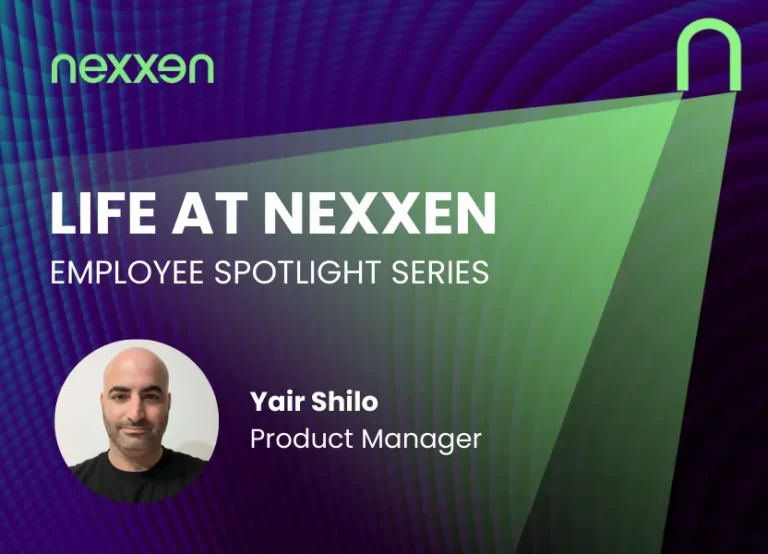
Life at Nexxen is a blog series spotlighting our employees – from their career journeys and go-to advice to the rituals and activities that make up their days here at Nexxen. In this edition of Life at Nexxen, we spoke with Yair Shilo, a Product Manager based in our Tel Aviv office.
How did your journey at Nexxen start?
I joined Taptica in 2017 in Publisher Relations, supporting mobile UA. That role gave me foundational exposure to adtech, supply dynamics, and performance-driven buying. I later transitioned into Tremor Video DSP as a Programmatic Trader, eventually managing and directing teams. Those years shaped my product philosophy: capabilities should accelerate decision-making, not slow it down.
What led you from Director of Programmatic Operations into Product?
I’ve always been drawn to removing operational friction. If something is repetitive or slows teams down, I immediately start thinking about how to streamline or automate it.
Over time, I became a natural bridge between Ops and Product, translating pain points into solutions and helping validate improvements. Moving into Product allowed me to scale that impact across all users, not just a single team.
Can you describe the DSP org and your role within it?
Our DSP Product organization is split across UX and runtime. I sit within the UX group, owning reporting, analytics, and the core DSP UI workflows. My work focuses on turning complex programmatic data into actionable insights and designing flows that help traders move faster, make better decisions, and avoid costly mistakes.
I collaborate closely with engineering and design as well as other PMs to define problems, shape solutions, and ship capabilities that streamline the campaign lifecycle. I believe in keeping teams flat and collaborative so decisions move quickly and context stays close to the people building the product.
How do Product Managers work with Engineering at Nexxen?
I partner with a dedicated, domain-focused engineering team called FLY. My role is to translate user and business needs into clear requirements, prototype solutions directly, often using Vibe coding, and work with design on the final user experience.
Engineering brings technical insight and feasibility checks, and together we iterate until we land on a solution that addresses the underlying problem, not just the initial request. A flat, open working style, supported by AI-assisted tools, helps us iterate faster and stay aligned.
How do Product teams source and use user feedback?
We collect feedback through direct conversations, internal teams, feature requests, structured UX sessions, and surveys.
The hard part isn’t collecting feedback – it’s prioritizing it. I look for patterns that impact workflow efficiency, clarity, or performance. When multiple signals point to the same friction point, that becomes a priority. My focus is on filtering noise and ensuring we address the issues that truly matter.
You were involved in the Tremor – Amobee DSP consolidation. What helped you and your team complete that project?
The consolidation was one of the most challenging and high-impact efforts I’ve worked on. We had to merge workflows and standardize operations across two DSPs while keeping active campaigns healthy.
We succeeded because of strong cross-functional alignment and a willingness to challenge legacy assumptions when they held the platform back. It required focus, trust, and a shared belief in building something better.
Do you have a routine that helps you start or end your workday?
My mornings always starts with a cup of coffee, and syncing with my engineering partners. Quick hallway conversations with other PMs often solve problems faster than formal meetings.
How do you spend your time outside of work?
Most of my time goes to my four kids: a 7-year-old, a 5-year-old, and 1-year-old twins. When I get a rare quiet moment, you’ll usually find me running, watching almost any elite sports I can find, or losing myself in a TV series a puzzle, or a quick brain game. I used to travel and play guitar more often, but these days, squeezing in those passions feels like a little victory.
A closing thought?
I believe every problem has a solution. I like to challenge existing paradigms, cut through noise, and break down complex challenges together with the people closest to the work. I’m lucky to work with incredibly bright, fun people who make the tough problems energizing rather than overwhelming. That’s what motivates me. Building capabilities that create real impact, and today, with AI and new tools, there’s an even greater opportunity to do so.